

Chief Information Officer Job Description
Chief Information Officer Job Description - What is the Chief Information Officer (CIO)? The title Chief Information Officer (CIO) was first used inside the information technology department and function to identify the person responsible for all Information Technology functions within the enterprise. In many enterprises, the term CIO is still used this way.
At the same time job tenure is only between 4 to 5 years. Less than it is for other top level executives.
To succeed today, the CIO needs a very unique skill set. Superb public speaking and leadership skills, well-grounded in technology, an understanding of corporate finance, and a deep understanding of—and the ability to directly relate to—the business.
Where CIOs must prove their business worth is in their ability to address business and management tasks and to go far beyond the infrastructure support that was all they were once known for. Today, cost reduction is such an obvious function of the IT organization that it's hard to remember that just a few short years ago it meant only cutting IT budgets. But now technology enters the cost-cutting conversation at a strategic leve - with hybrid IT/line-of-business initiatives that affect business expenditures as a whole.
IT leadership has always been important, but given the challenges facing higher education, it is essential for not only cost-effective operations but long-term strategic success. The CIO is the driver for this.
CIOs and CTOs of the Future
The CIOs and CTOs of face many challenges. The CIOs and CTOs who will succeed will have a common set of skills.
- CIOs and CTOs will be both visionary and pragmatic - It is not enough to plan for innovation, they need to be perceptive and realistic. As an insightful manager they prompts a broad technology agenda to help the business profit from leading-edge initiatives. At the same time as a pragmatist, they deal with the realities of the business. The pragmatist also facilitates the productivity of current IT solutions. The CIO and CTO focuses on minimizing cost and maximizing results, in addition they help to increase the customer and product/service base of the enterprise.
- CIOs and CTOs will be focus on ROI improvement of IT - CIOs and CTOs will find new ways to help customers and the organization profit from how data is used while focusing on managing budgets and processes to eliminate or reduce costs.
- CIOs and CTOs will inspire the enterprise and expand the business impact of IT – CIOs and CTOs will have proven expertise in both business and technical facets of their role. they will interact with the enterprise and its executive team as enterprise leaders and drive new business initiatives and shifts jointly the other members of the executive team.
Role of CIO and CTO
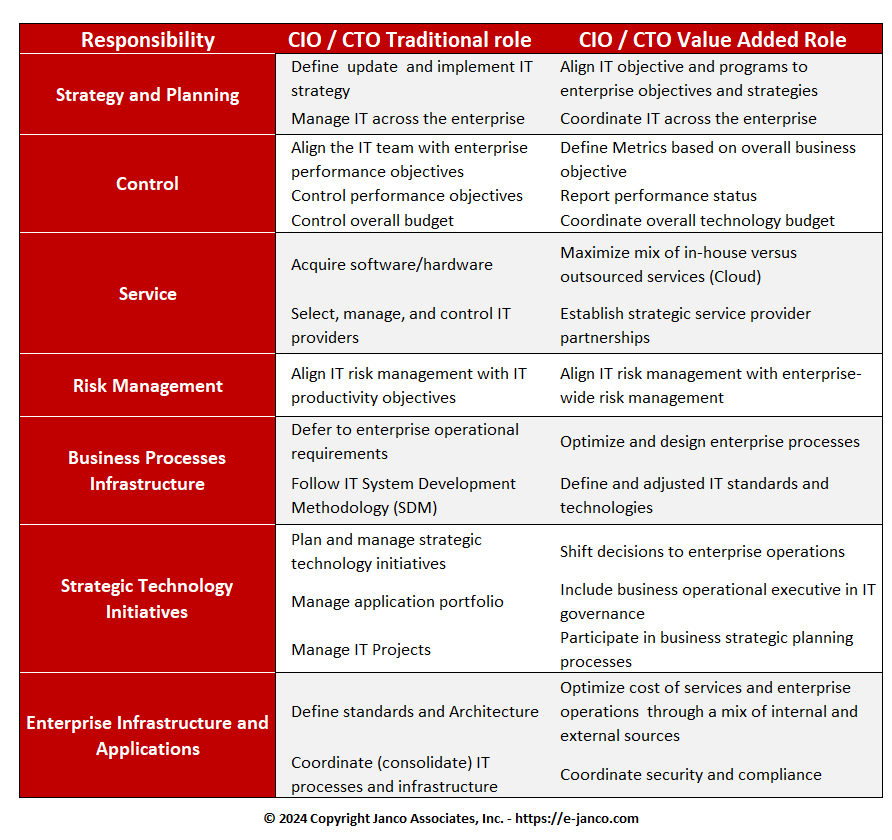
The role of the CIO and CTO is changing as more enterprises more towards a "Value Added" role for the Information Technology function. Those changes are depicted in the detail job descriptions that have been created for all of the functions with IT -- especially for the CIO and CTO. The table below depicts several of those changes.
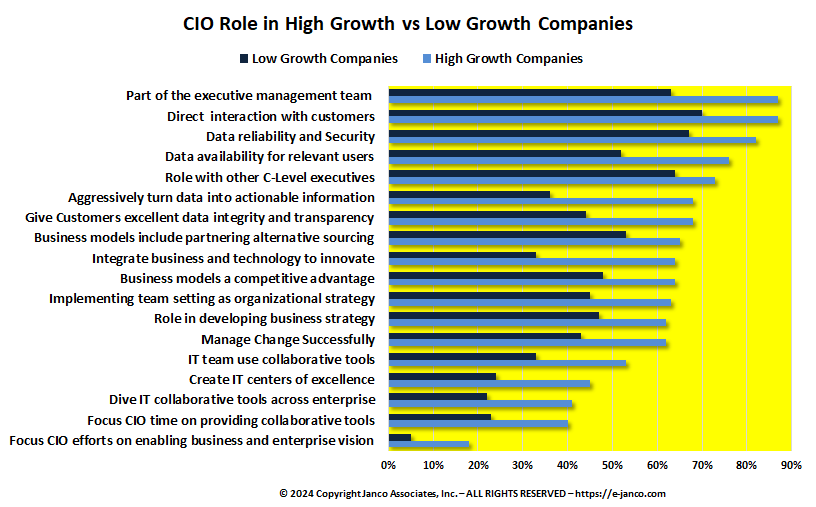
CIO CTO in High Growth vs Low Growth Enterprises
Chief Information Officer - Position Purpose
The Chief Information Officer (CIO) is accountable for directing the information and data integrity of the enterprise and its groups and for all Information Technology functions of the enterprise. This includes all data centers, technical service centers, production scheduling functions, help desks, communication networks (voice and data), computer program development, and computer systems operations. He or she is responsible for maintaining the integrity of all electronic and optical books and records of the enterprise.
The CIO reviews all computerized and manual systems; information processing equipment and software for acquisition, storage and retrieval; and definition of the strategic direction of all information processing and communication systems and operations. He or she provides overall management and definition of all computer and communication activities within the enterprise including responsibility for providing a leadership role in the data to day operations of the Information Technology functions as well as providing direction as the enterprise grows through internal growth and external acquisition.
The CIO interacts with the executive management team to monitor and validate the enterprise’s compliance with its security policies, which includes but is not limited to Sarbanes Oxley Section 404. In addition the CIO works closely with the Chief Security Officer of the enterprise
A full 5 page Chief Information Officer (CIO) job description can be downloaded immediately.
Internet
and IT
Position Descriptions HandiGuide®
331 job Descriptions Descriptions and Organization Charts
Order IT Job Descriptions Download TOC Sample Job Descriptions
| Format | Modify Source | Cut & Paste | Features |
Cost** | ||
| Yes | No | No | The complete Internet and IT Position Descriptions HandiGuide which includes the Job descriptions in PDF formats which utilizes the Adobe search and bookmark features. | Less than $3.44 each | Order Now | |
| Word Files |
Yes | Yes | Yes | Individual files for each job description. Long file names are used so each job description can be modified as a simple document (WORD.docx) - Bonus of ePub version of all of the job descriptions | Less than $3.83each |
Order Now |
| Word Book |
Yes | Yes | Yes | Word Search Fully Bookmarked. All job descriptions are contained in single word book - NOTE this is a complex document and the user needs to know WORD very well to extract and modify the individual job descriptions (WORD.docx) | Less than $4.59 each | Order Now |
| PDF and Word Files |
Yes | Yes | Yes | The complete Internet and IT Position Descriptions HandiGuide plus individual files for each job description. Long file names are used so each job description can be modified as a simple document (WORD.docx) | Less than $5.75 each | Order Now |